Visit Bordeaux in Two Days
At a Glance
Is 2 Days Enough to Visit Bordeaux?
Bordeaux has 350 UNESCO-listed buildings, the largest protected area in France after Paris. There’s no need to see everything: the key is choosing wisely. Spend a first day wandering the cobbled streets of old Bordeaux aboard our Hop-on Hop-off bus, and a second day visiting monuments and districts further from the city centre. The city reads like an open book: every stone tells the story of the Port de la Lune, the great 18th-century wine merchants, and the Haussmann-style architecture that made Bordeaux one of the most beautiful cities in France. If you have an extra day, check out our page on Visit Bordeaux in Three Days to go further. And if you only have one day, our one-day itinerary will guide you to the essentials.
Day 1
Bordeaux’s Historic Heart on Foot
The first day is lived at the city’s own pace. Start in the Saint-Pierre district, the oldest in Bordeaux, and let yourself be carried towards the quays. The itinerary below covers around 5 km of walking, with as many stops as there are good reasons to pause.
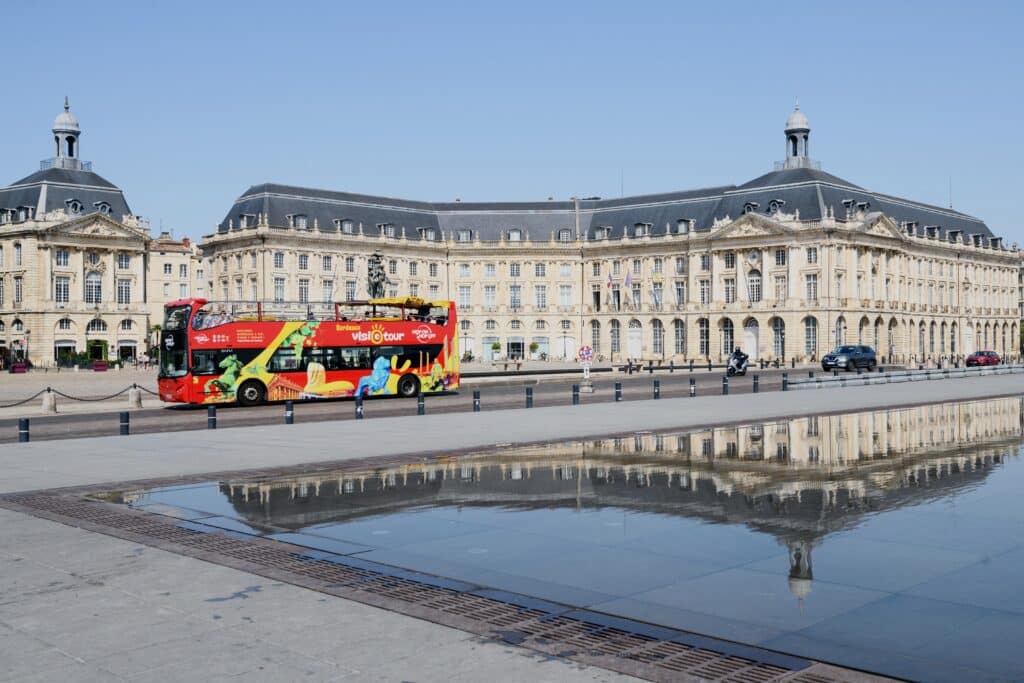
Start with Bordeaux’s most famous image: the Water Mirror opposite Place de la Bourse. This 3,450 m² reflecting pool, the largest in the world, mirrors the classical 18th-century façade with painting-like precision. It’s at its most beautiful in the morning, before the crowds arrive. Created by Jean-Max Llorca, it has become the unmissable emblem of Bordeaux’s renewal.
Just steps from the quays, the Saint-Pierre district is Bordeaux’s medieval heart. Its cobbled lanes, honey-coloured stone façades and hidden courtyards conceal centuries of merchant history. Don’t miss the Porte Cailhau, a 15th-century triumphal gate standing at the city’s entrance on the Garonne side — it marks the site of the old river port.
From Saint-Pierre, head up to Place Pey Berland — fully renovated in recent years. Saint-André Cathedral, a UNESCO World Heritage Site since 1998, stands there in full Gothic splendour. Right next to it, the Pey Berland Tower offers, from its 66 metres, an exceptional panorama over the rooftops of Bordeaux — a climb of 233 steps you’ll never regret.
Head to Place des Quinconces, one of the largest squares in Europe at 126,000 m². The Monument to the Girondins, with its bronze horses seeming to rise from the water, is one of the most spectacular sculptural ensembles in France. It is also the starting point of our Hop-on Hop-off bus.
End your first day in the Chartrons, the district of the great wine merchants of the 18th century. Now home to art galleries, antique shops and wine cellars, it embodies contemporary Bordeaux without denying its origins. The redeveloped quays along the Garonne are perfect for dinner by the river as the city lights up.
💡 Bordeaux City Tours Tip
To make the most of this first day, start early: the Water Mirror and the quays are stunning from 8am, before the crowds arrive. Plan a lunch break at the Marché des Capucins, a 10-minute walk from the Saint-Pierre district, to sample Bordeaux’s flavours.
Day 2
Choose How You Explore Bordeaux
On the second day, Bordeaux City Tours offers several ways to continue your discovery. Depending on your mood, pace and appetite for depth, each option offers a different perspective on the city.
| Option | Duration | Format | Ideal for |
|---|---|---|---|
| Hop-on Hop-off Bus Popular | 1h10 without stops | Panoramic bus, audio guide, available as 24-hour and 48-hour passes | Families, first-time visitors, reduced mobility, taking time to discover Bordeaux |
| Guided Walking Tour | 2h | Small group, professional guide | History and architecture enthusiasts |
| Tourist Train | 45 min | Small train departing from Place Tourny | Families, first-time visitors, reduced mobility, short on time |
| Garonne River Cruise | 1h to 2h | Boat, view from the river | Couples, unusual experience, sunset |
The Hop-on Hop-off Bus: Visiting Bordeaux from a Panoramic Bus
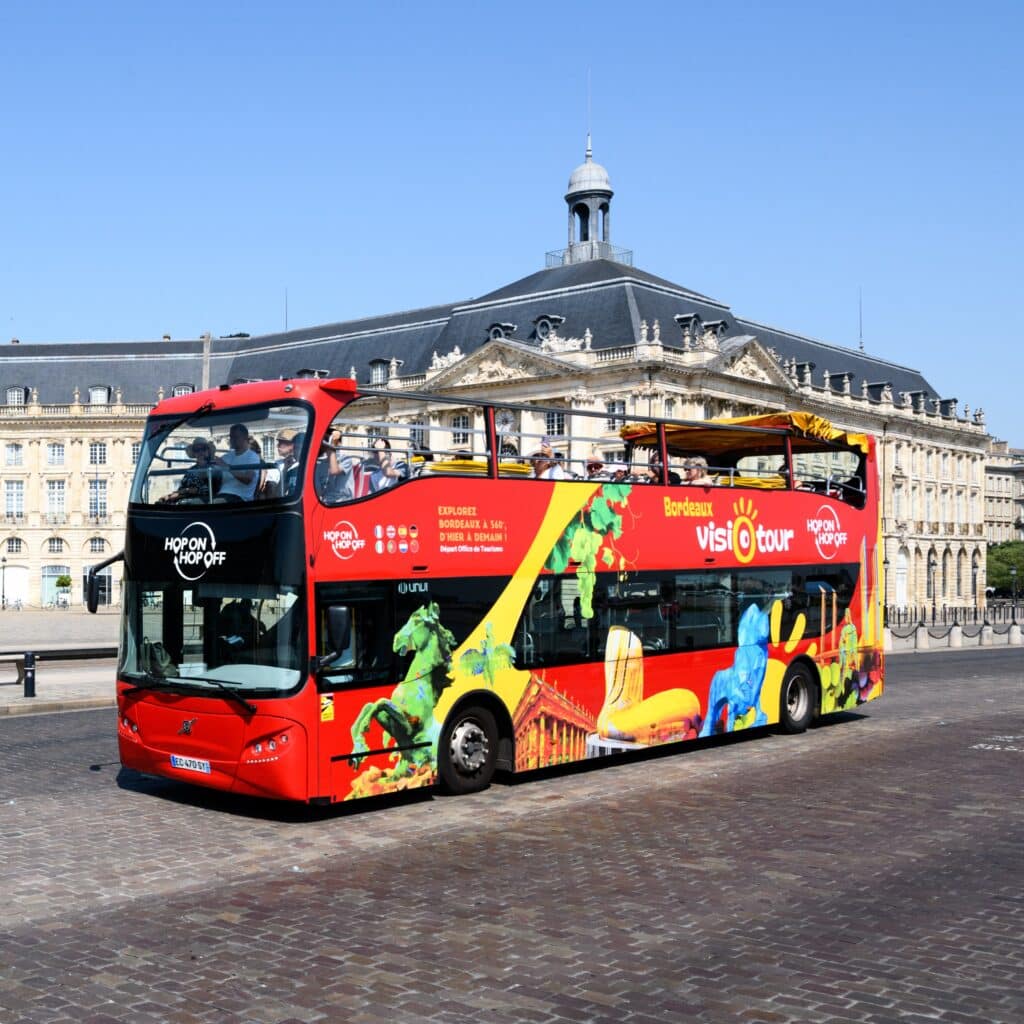
The red bus is the most complete way to discover Bordeaux. In 1h10 without stopping, or over 24h/48h hopping off at each monument, this open-top panoramic bus takes in Bordeaux’s major landmarks: Place des Quinconces, the Grand Théâtre, the Garonne quays, Place de la Bourse, the Pont de Pierre and La Cité du Vin. The audio commentary, available in 8 languages, tells the story of each site and monument. A commentary specially designed for children is also available. A must for families and visitors who want to take in the whole city and discover Bordeaux from its past to the present day.
In practice, three options adapt to your pace: the 24h pass (hop on and off freely, every 35 minutes) from €22 per person, the 48h pass from €26, or the non-stop 1h20 tour from €14 (€16 adult fare for the last three departures of the day, at 3.45pm, 4.20pm and 4.55pm). Wifi is free on board, and the starting point is the Quinconces stop, 10 cours du 30 Juillet, right in front of the Tourist Office. The Visiotour is Tourisme et Handicap certified, with a dedicated space for passengers with reduced mobility, and has been actively pursuing a CSR approach since January 2022.
“The best way to discover Bordeaux in a day, ideal for seeing the iconic buildings.”
Alice, a Bordeaux local
The Guided Walking Tour: Discovering Old Bordeaux
If yesterday you wandered freely, today you dive into the substance. Guided walking tours are led by passionate professional guides who know Bordeaux down to its smallest corners. In two hours, you’ll understand why the city was one of the wealthiest in Europe in the 18th century, how wine merchants shaped its architecture, and what the neoclassical façades of Rue Sainte-Catherine reveal. The small-group format guarantees quality exchanges and a comfortable pace. Check with the tourist office for available times and departures.
Visiting Bordeaux Aboard the Tourist Train
Bordeaux’s tourist train takes you to the heart of the historic city centre for a commentated tour of about 45 minutes. Departing from Allées de Tourny, it passes the main monuments and iconic sites, such as Place de la Bourse, the Water Mirror, the Garonne quays, the Grosse Cloche or Saint-André Cathedral. This non-stop route is ideal for discovering Bordeaux’s heritage comfortably and accessibly.
Discover Bordeaux from the Garonne, by Cruise
The Garonne river cruise offers an original way to discover Bordeaux from the water, with a privileged view over the quays, Port de la Lune, Place de la Bourse, La Cité du Vin and the city’s main bridges. For around 1h30, a guide shares the history and anecdotes of the Girondin capital, while passengers enjoy a Bordeaux wine tasting accompanied by a traditional canelé.
Our Must-Sees for a Weekend in Bordeaux
What you shouldn’t miss in two days — with the time needed for each stop.
How Much Time Do You Need to Visit Bordeaux?
Bordeaux is a city designed to be experienced slowly. Its pedestrian centre concentrates the essentials of its listed heritage within less than 3 km². The quality of a stay in Bordeaux isn’t measured in monuments ticked off, but in moments captured: the smell of the Marché des Capucins in the morning, the late-afternoon light on the honey-coloured stone of the Chartrons, the sky reflected in the Water Mirror at golden hour. For families, Bordeaux is best visited over two full days. For couples or longer-haul travellers, a three-night stay allows you to add a tasting session in the Chartrons or a visit to MÉCA, the Maison de l’Économie Créative and Culture de Nouvelle-Aquitaine.
The Bordeaux City Tours Tip
For a successful weekend in Bordeaux, take the time to explore the districts, independent little shops and the more famous monuments. This mix of wandering and expert insight ensures you won’t miss anything essential, and that you’ll leave wanting to come back.
We also have group offers and gift cards so you can give the gift of a weekend in Bordeaux — a present that never goes out of style in the wine capital.